Salt Spray Testing: 24 to 480 Hours Explained
Salt spray testing is an accelerated corrosion evaluation protocol that simulates years of coastal exposure in 24-480 hours under controlled saline mist. Procurement managers in coastal regions often have to consider the salt spray resistance of padlocks and security hardware to ensure longevity and reliability.
This article examines the intricacies of salt spray testing, focusing on how the duration of exposure affects product choice and what it reveals about real-world performance.
How Salt Spray Testing Works
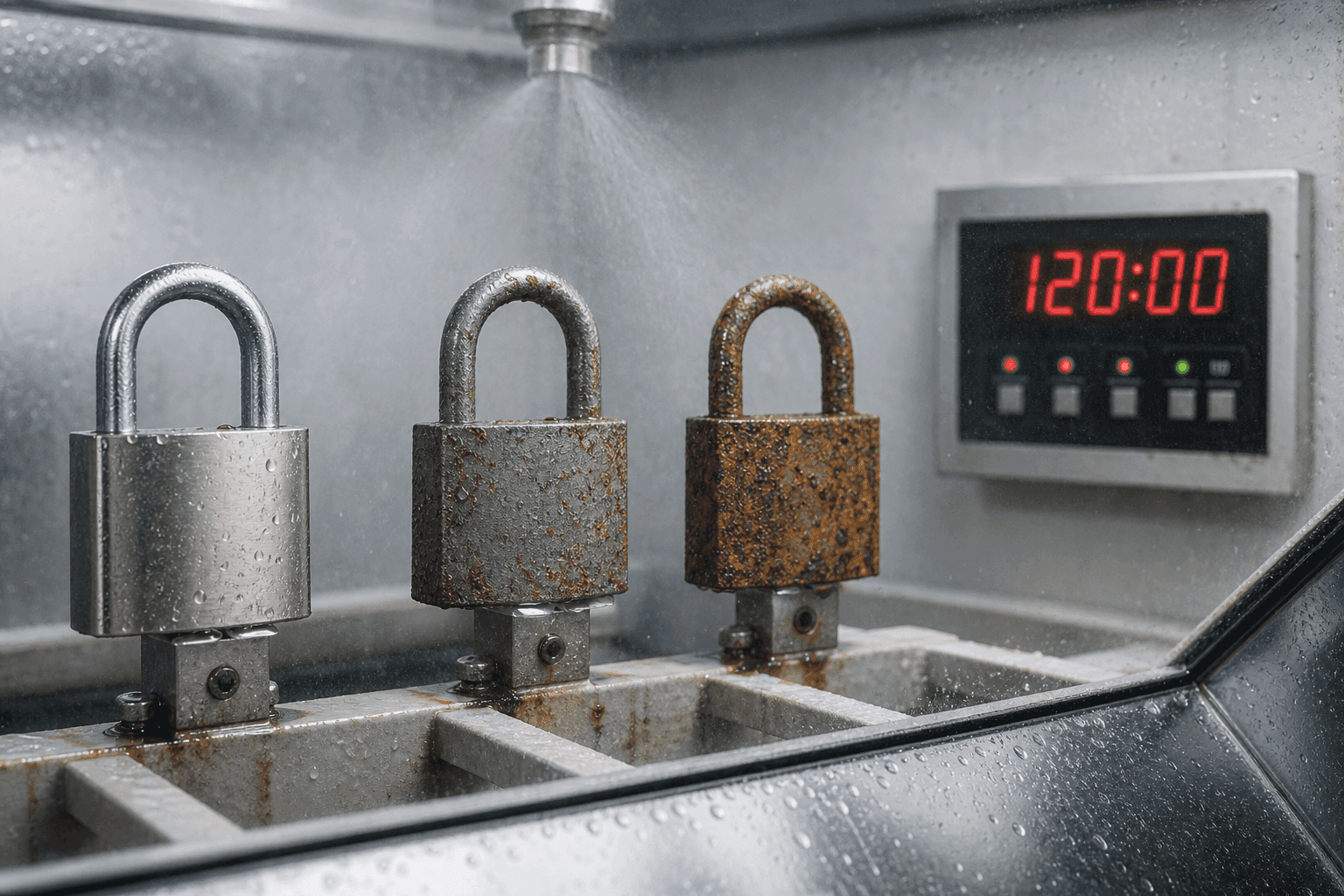
Salt spray testing, conducted per the ASTM B117 standard, involves placing a substrate in a chamber where a saline mist is continuously sprayed. The test evaluates corrosion resistance by exposing hardware to salt mist for periods ranging from 24 to 480 hours. The longer the duration, the greater strain on the material’s protective coatings.
This protocol allows manufacturers to predict how products will fare in harsh environments. For instance, a padlock subjected to 480 hours of salt spray tests under conditions simulating high-salinity coastal air can offer assurance of its longevity in marine environments.
Comparing Salt Spray Durations
The difference between 24-hour versus 480-hour salt spray tests lies in exposure and realistic corrosion simulation. A 24-hour test might suffice for products used in less demanding environments, whereas products subjected to continuous exposure, such as in ports, would benefit from ensuring 480-hour resistance. According to ASTM, more extended testing periods correlate closely with real-world longevity and durability in sea air.
Understanding these implications assists procurement managers in making informed decisions regarding cost versus durability, which is crucial for high-corrosion zones like coastal warehouses.
Real-World Correlation
Neutral salt spray protocol results must correlate with real-life conditions to be valid. While these tests accelerate the corrosion process, they might not cover all environmental factors like UV exposure or pollution. Hence, while a 120-hour test shows resistance, consulting additional data on UV and temperature impacts remains critical.
Entities such as the ISO and ANSI often work on developing complementary standards to offer a comprehensive environmental resistance profile. This reinforces the importance of a multi-faceted approach to testing.
Explore our comprehensive padlock and smart security solutions for OEM/ODM requirements.
Industry Adoption and Standards
In China, manufacturers like those in Jiangmen, Guangdong, run rigorous salt spray testing as part of quality control. For example, factories with in-house mold workshops, such as Yuefong Lock, achieve excellent precision and durability ratings. This underlines the ability of some Chinese factories to meet and exceed ASTM B117 criteria, ensuring salt spray durability aligns with global standards.
Procurement managers are advised to familiarize themselves with both domestic and international standards like SASO and ISO to ensure they select products meeting the necessary durability thresholds.
Frequently Asked Questions
What is ASTM B117?
ASTM B117 is a standard for salt spray testing, simulating accelerated corrosion under controlled saline conditions.
How does 480-hour salt spray testing compare to real life?
The 480-hour test simulates long-term coastal exposure, indicating how a product will perform in marine environments.
Can salt spray testing predict UV damage?
Salt spray testing alone does not account for UV exposure; additional tests are recommended.
Industry References
Version 1.0 — Published July 6, 2026 · Editorial review window: 90 days