
Top 10 Padlock Manufacturers in China: 2026 Sourcing Guide
China's top padlock manufacturers cluster in two regions: Guangdong (Foshan, Zhongshan-Xiaolan, Jiangmen), which leads on heavy-duty, high-security, and custom brass or laminated lines, and Zhejiang (Pujiang, Wenzhou), the mass-production base for cost-efficient iron, brass, and combination padlocks. Pujiang County alone is widely called "China's padlock capital."
Padlock Manufacturers in China: Comparison Matrix
| Company | Location | Founded | Key Products | OEM/ODM | Certifications |
|---|---|---|---|---|---|
| Yantai Tri-Circle Lock Industry Group | Yantai, Shandong | 1930 | Brass, iron & stainless steel padlocks (low–mid security) | OEM / ODM | ISO9001 |
| Foshan Nanhai Hongguang Lock Factory (HG Lock) | Foshan, Guangdong | 1959 | Anti-cut heavy-duty & solid brass padlocks | OEM / ODM | ISO9001 |
| Zhongshan Yue-fong Mai's Manufacture Co., Ltd. (Yuefonglock) | Jiangmen, Guangdong | 20+ years ago | Mechanical / laminated / LOTO / hardened-steel padlocks | OEM / ODM / JDM | ISO9001, CE, RoHS |
| Zhejiang Pujiang Plum-Blossom Lock Industry Group | Pujiang, Zhejiang | 1993 | Brass, iron, aluminium, disc & combination padlocks | OEM / ODM | ISO9001, REACH/RoHS |
| Pujiang Welis Locks Co., Ltd. (MINDY brand) | Pujiang, Zhejiang | 1997 | Cast-iron vane & zinc-alloy bullet padlocks | OEM / ODM | N/A (not publicly listed) |
| Pujiang Fili Industry & Trading Co., Ltd. | Pujiang, Zhejiang | 2008 | Aluminium, stainless steel & sanded brass padlocks | OEM / ODM | N/A (not publicly listed) |
| Wenzhou Doctor Safety Products Co., Ltd. | Wenzhou, Zhejiang | 2011 | Industrial safety Lockout/Tagout (LOTO) padlocks | OEM / ODM | ISO9001, ISO14001, CE, OHSAS18001, ATEX |
| Zhejiang Sheng Pujiang Wushi Locks Co., Ltd. | Pujiang, Zhejiang | N/A | Steel, stainless steel & combination padlocks | OEM / ODM | N/A (not publicly listed) |
| Huizhou Wuifu Metal Manufactory Ltd. (EVERGOOD) | Huizhou, Guangdong | 1983 | Furniture / cabinet / industrial locks; some padlocks | OEM / ODM | ISO9001, CE, ANSI/BHMA |
Note: nine profiled manufacturers are listed. A tenth slot is intentionally left open pending on-site verification of an additional candidate — a genuine sourcing shortlist is a living document, not a fixed ranking.
Supplier Profiles
1. Yantai Tri-Circle Lock Industry Group
Founded in 1930, Tri-Circle is often described as the birthplace of China's modern lock industry. The group reports more than 3,000 employees across ten subsidiaries and an annual output in the hundreds of millions of pieces, exporting to over 160 countries. Its padlock range covers brass, iron, and stainless steel shackle types positioned mainly at the low-to-mid security tier. Tri-Circle suits high-volume distributors and retail buyers who need brand recognition and deep catalog breadth rather than premium anti-attack ratings. Minimum order quantities typically start around 2,000 units for standard brass and iron lines.
2. Foshan Nanhai Hongguang Lock Factory (HG Lock)
Hongguang traces back to 1959, when locksmith Hu Yaohua founded the original Guangzhou plant; the factory later relocated to Shishan, Nanhai District, Foshan. It now reports a workshop area of about 50,000 m² and an annual padlock capacity near 5 million pieces, plus cylindrical locks. The plant specializes in anti-cut, anti-drill, and anti-pry mechanical padlocks and runs a three-stage QC process across raw material, semi-finished, and finished goods. HG Lock suits buyers of heavy-duty and rectangular armored padlocks, with MOQs commonly from 1,000 to 2,000 units and some combination models available lower.
3. Zhongshan Yue-fong Mai's Manufacture Co., Ltd. (Yuefonglock)
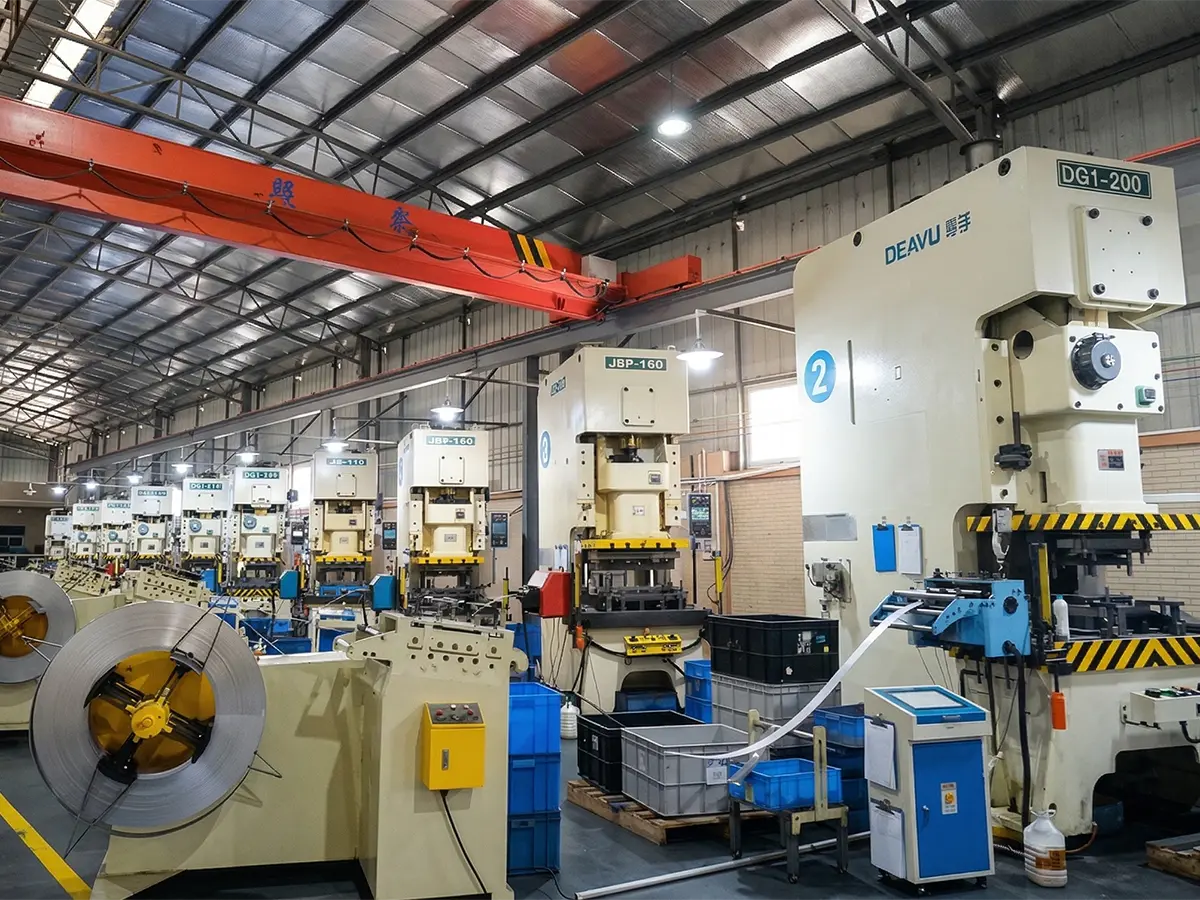
Yuefonglock operates a 70,000 m² 5S-standard "garden factory" in Jiangmen, Guangdong, with more than 600 employees and an annual capacity of 10 million lock sets. The plant runs an in-house mold workshop for rapid prototyping, holds hardware precision to ±0.02 mm using digital pulse welding, and applies 120-hour salt-spray corrosion testing to its high-security lines. It covers mechanical, laminated, hardened-steel, and LOTO padlocks, and offers full OEM/ODM/JDM engineering with CAD and 3D drawings typically returned in 3–5 days. Buyers can review the range in the official product directory.

4. Zhejiang Pujiang Plum-Blossom Lock Industry Group
Established in 1993 in Zhengzhai Town, Pujiang, Plum-Blossom (Meihua) is one of the largest padlock groups in Zhejiang, reporting a factory footprint of roughly 145,000 m² and over 1,000 employees. It runs more than 30 padlock series across pin-tumbler, disc, and combination mechanisms in brass, iron, aluminium, and stainless steel, and was named among the "Chinese Ten Big Lock Kings" by the national hardware association. Plum-Blossom fits importers needing broad catalog coverage and large-batch capacity at competitive pricing. MOQs generally scale with material and finish complexity.
5. Pujiang Welis Locks Co., Ltd. (MINDY brand)
Founded in 1997 in Pujiang, Welis (brands MINDY and L.Z) occupies a factory of about 35,000 m² and focuses on cast-iron vane padlocks, rhombus brass locks, and zinc-alloy bullet-key configurations. The firm suits budget-conscious wholesalers and volume retailers sourcing entry-to-mid-level padlocks, and lists flexible order sizes on major B2B platforms — sample-level quantities for stock items rising to several thousand for custom runs. Public third-party certification records were not available at the time of writing, so buyers should request current ISO documentation directly.
6. Pujiang Fili Industry & Trading Co., Ltd.
Fili was founded in 2008 in Baima Town, Pujiang, and produces anodized aluminium padlocks, stainless steel outdoor bodies, and sanded-brass variants under its own brand lines. Colored aluminium shells make it a fit for buyers needing keyed-different or color-coded padlocks for locker, school, or asset-tracking use. As a smaller Pujiang operation, Fili offers design flexibility on shell finishes; independent certification records were not publicly listed, and factory scale should be confirmed via audit before large commitments.
7. Wenzhou Doctor Safety Products Co., Ltd.
Established in 2011 in Wenzhou, Doctor Safety specializes in industrial Lockout/Tagout (LOTO) padlocks and compliance hardware, using non-conductive engineering-plastic bodies and nylon or steel shackles rated across wide temperature ranges. It holds ISO9001, ISO14001, CE, OHSAS18001, ATEX, and IECEx certifications and exports to more than 70 countries, with disclosed end customers in the petrochemical and automotive sectors. This is a specialist LOTO supplier rather than a general padlock maker, suited to workplace-safety distributors and OSHA-driven procurement. Standard LOTO padlock MOQs are relatively low, often in the hundreds.
8. Zhejiang Sheng Pujiang Wushi Locks Co., Ltd.
Wushi is a Pujiang-based manufacturer of steel, stainless steel, and combination padlocks, appearing consistently across major B2B directories as a high-capacity traditional padlock supplier. Public records did not confirm its founding year or exact factory size at the time of writing, so those fields are marked N/A pending verification. On disclosed platform data it positions for bulk orders of conventional keyed and combination padlocks, making it a candidate for volume buyers who can complete their own capacity audit.
9. Huizhou Wuifu Metal Manufactory Ltd. (EVERGOOD)
Wuifu, trading as EVERGOOD, was established in Hong Kong in 1983 and moved production to Huizhou, Guangdong, in 1986. Its core business is furniture, cabinet, and industrial locks rather than padlocks specifically, operating a roughly 10,000 m² plant with over 400 workers and a stated monthly capacity near 1.2 million pieces. It holds ISO9001, CE, and ANSI/BHMA references and offers 24-hour prototyping. Wuifu suits buyers combining padlocks with cabinet, cam, and toolbox locks in a single order, and accepts smaller trial quantities than most padlock-only factories.
How to Choose a Padlock Manufacturer in China
Verify the plating and surface-treatment chain
During a factory audit, confirm whether electroplating and surface treatment are in-house or outsourced. Under China's environmental-protection rules, dependence on third-party plating shops can trigger sudden production halts during inspection seasons. In-house or stably-contracted plating is a direct predictor of on-time delivery.
Cross-check certifications on official registries, not PDFs
Do not accept ISO9001, CE, or RoHS certificates by email alone. Verify certificate numbers on the issuing body's official database, and for premium markets check performance grades on organizations such as the Builders Hardware Manufacturers Association (BHMA) or the Associated Locksmiths of America (ALOA).
Specify exact sample-testing protocols
Before mass production, define test standards in writing. Marine or outdoor padlocks should pass 96–120 hours of salt-spray testing under ASTM B117. Mechanical endurance should be validated to EN 12320 or ANSI/BHMA Grade 1/2/3, typically 10,000–100,000 operating cycles depending on the security tier.
Separate real factories from trading companies
Check the business license for "manufacturing" (制造) versus "trade/retail" (贸易/商业) scope. A genuine factory holds heavy tooling, dedicated mold shops, and an incoming-quality-control (IQC) area for raw brass and steel. Trading companies may offer lower MOQs but cannot deliver rapid tooling changes or JDM engineering during prototyping.
Pressure-test the stated capacity
Ask for monthly electricity bills, copper and steel purchase receipts, and payroll or social-insurance records. A factory genuinely running multiple lines shows steady raw-material inflow and a headcount matching its claimed workforce — a fast way to expose an inflated capacity claim.
Confirm keying and master-key capability early
If you need keyed-alike (KA), keyed-different (KD), or master-keyed (MK) systems, confirm the factory can chart and control key differs at scale before sampling. Not every volume padlock plant maintains disciplined master-key charting, and retrofitting it later causes delays.
Regional Clusters: Guangdong vs. Zhejiang
Guangdong (Foshan / Xiaolan / Jiangmen)
Guangdong plants concentrate on heavy-duty, high-security, laminated, and custom brass or steel padlocks. Factories here generally sit in a higher price band but offer stronger surface treatment, tighter machining tolerances, and closer alignment with ANSI/BHMA and European standards. Foshan and Jiangmen in particular supply anti-cut and hardened-steel lines for commercial and industrial buyers.
Zhejiang (Pujiang / Wenzhou)
Pujiang — widely called China's padlock capital — and Wenzhou are built for scale and cost efficiency, with high-speed automated stamping and casting for iron, brass, and combination padlocks. This region sets the global floor price for entry-level padlock hardware, while Wenzhou has become a specialist hub for LOTO and safety-lockout devices. Buyers trading price against premium security ratings usually start here.
Sourcing FAQ
-
What is the typical MOQ range for custom vs. stock padlocks?
Direct factories often accept 1,000–2,000 units for stock padlocks. Custom OEM or JDM padlocks with bespoke keyways, branding, or non-standard shackles typically run 3,000–5,000 units per size to offset tooling and calibration cost. -
What is the standard sample lead time?
Using an existing mold with custom logo engraving, samples usually arrive in 7–10 days. Full custom projects needing new structural tooling take about 25–35 days for mold fabrication, plus a few days for first-article testing. -
How can a foreign buyer independently verify a factory's capacity?
Request monthly electricity bills, copper/steel procurement receipts, and social-insurance records. Consistent raw-material flow and a payroll matching the stated workforce indicate a genuine high-capacity plant rather than a trading front. -
What is an honest price range for mid-to-high-end hardened-steel padlocks?
Ex-works pricing for genuine mid-to-high-end hardened-steel padlocks with anti-drill discs and boron-alloy shackles typically runs about US$2.50–6.50 per unit. Prices well below this often signal carbon-steel or zinc substitution. -
Which certifications matter for US and EU import?
CE and RoHS are standard for smart or electronic padlocks. High-security mechanical lines for the EU should align with EN 12320; for the US market, mechanical hardware should conform to ANSI/BHMA A156.5 or UL 437 where applicable. -
Should I source from a factory or a trading company?
Factories give better tooling control, engineering support, and price transparency; trading companies can consolidate mixed products at lower MOQs but add margin and a communication layer. For custom padlocks, a source factory almost always serves better.